|
9/21/2014 Film historian and fans: I need your expertise (but first, a note about a pain in the neck)Read Now The teamwork of stars made United Artists. From left: Charles Chaplin, Douglas Fairbanks Sr., and Mary Pickford. The teamwork of stars made United Artists. From left: Charles Chaplin, Douglas Fairbanks Sr., and Mary Pickford. No film report today. I'm starting to get my brain back since my car accident. No, it wasn't a huge one, thank goodness. My car only had a little damage to the bumper, but my brain apparently got rattled when the car rear-ended me while I was at a complete stop. I got hit at the end of August and have just this weekend had a few hours here and there where I felt just about back to my usual self. Don't let anyone tell you that whiplash or neck sprain/strain isn't a big deal. After having a neck and headache almost constantly for the past three weeks, I can tell you it totally stinks.
I really did stink. Not only have I had head and neck aches, my concentration levels have been terrible. I LOVE doing research and reading. They are two of my favorite things. I also love watching movies. Until last night and today, I haven't been able to focus long enough on anything to be able to get anything done for my book, read a book for fun or just watch a movie. But I did last night! I watched "Oculus" and liked it a lot. Yay for good scary movies! Of course now that I'm having some clarity, I want to do this, do that, do this and that, and read, and research, and contact people for interviews and look up the ones I already have, and watch a movie, and read a book for fun, and read more books for research, and ... Yeah, that's how my minds goes. Even before the car accident. At least before the accident I could do some of these things. I could focus on something, even if I had to tell parts of my brain to knock it off and do only one thing at a time. Well, I'm damming up the gush of thoughts and only letting some trickle through. Thus, the main point of this post ... **************** • I am currently seeking FILM HISTORIAN and EARLY FILM ENTHUSIASTS to share their thoughts on the importance of silent films. • I am seeking young fans of silent films who would like to share why silent films are still relevant to them and their generation. • Taphophiles are sought to talk about why cemeteries and memorialization are important today and for tomorrow. Do any of these questions strike you as something you'd love to answer? If so, email me at [email protected] or contact me via Twitter, Facebook, etc.
0 Comments
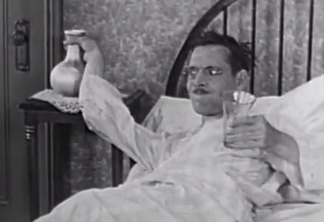 Henry Murdock - Click to watch film Henry Murdock - Click to watch film You may have noticed I haven't given myself a timeline on how long it will take me to watch 100 silent films. Knowing my schedule and current projects, I knew better than to say, "I'll watch a silent film each day!" I knew better than to say I'd watch one a week! I hope to do that, but I'm not putting unrealistic goals on myself. I've been down that road too many times. I actually watched "The Cat and the Canary" last week and just got my post up on it today. So today's actual "today" film is a two-fer. Today I watched the short "Cook, Papa, Cook" from 1928. It stars Henry Murdock and Lucille Hutton as a married couple who apparently don't like each other very much. It doesn't have the best storyline and puts all its weight on slapstick. It was loaded onto YouTube by Undercrank Productions. According to the description, it was "A lost silent comedy that turned up on eBay in 2011 without its opening titles, and one of the last films made by Henry Murdock (he choked to death unexpectedly at the end of 1928). Musical score by Ben Model © 2012 all rights reserved. Transferred from a sharp old 16mm print ...." I'm all for people finding lost films! According to the FindaGrave.com post for Lucille Hutton, she had a "non-cemetery burial." She died in 1970. I could find no records on the burial location of Henry Murdock. Do you know where the final resting places of these actors are? Let me know in the comments below. 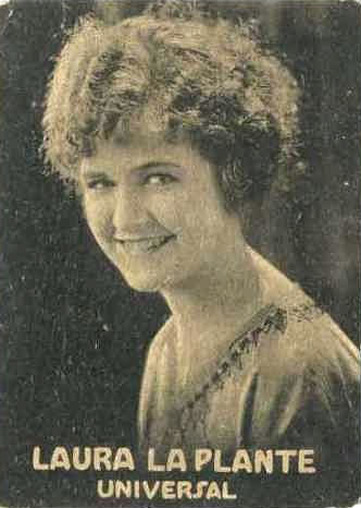 Laura La Plante - Susini y Bock Ovalados Tobacco Card, 1921 (Wikimedia Commons) Laura La Plante - Susini y Bock Ovalados Tobacco Card, 1921 (Wikimedia Commons) "The Cat and the Canary" is a Universal Pictures comedy horror film from 1927, directed by Paul Leni. It stars Laura La Plante, Creighton Hale, Forrest Stanley, Tulley Marshall, Gertrude Astor, Flora Finch and Martha Mattox (who plays creepy very well). One of the cool things is that the cast list is repeated at the end of the movie with this note: "This is repeated at the request of picture patrons who desire to check the names of those players whose work has pleased them."
The CinematicThoughts blog calls it "a powerful work of art, and ranks amongst the best horror films of the Silent Era." The blog also notes its "dramatic lighting, atmosphere and creative use of the camera (double exposures, strong composition and gliding shots)." Laura La Plante died in 1996, two weeks before her 92nd birthday. She is buried in El Camino Memorial Park in San Diego, California. (FindaGrave listing) Creighton Hale (born in1882 in Ireland as Patrick Fitzgerald) died in 1965. His FindaGrave.com listing says he was cremated at Chapel of the Pines Crematory then buried in Duncans Mills Cemetery in Duncans Mills, California. Gertrude Astor died on her 90th birthday in 1977. She is interred at Hollywood Forever's Abbey of the Psalms, Haven of Worship. It's spooky fun! 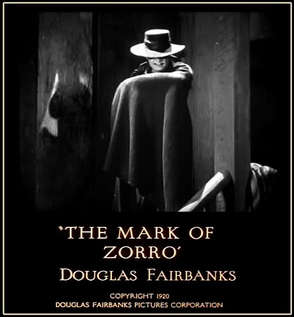 The fifth silent movie I watched was The Mark of Zorro from 1920. It stars the legendary Douglas Fairbanks (Sr.), who plays Zorro as well his alter ego Don Diego Vega. Fairbanks is just a whole lot of fun to watch. He preferred roles in which he could display is athleticism and agility. But while the sword fights and jumping here and there is entertaining, it's equally enjoyable to watch him as the foppish Don Diego. Don Diego is a schmuck. His dad wants him to hit it off with Lolita Pulido (Marguerite De La Motte), but his methods of wooing her fall flat--he does magic tricks, which she does not appreciate. He basically acts like a goof. But as Zorro, he's Mr. Suave. Douglas Fairbanks was born on May 23, 1883 in Denver, Colorado, and died at the age of 56 on Dec. 12, 1939 in Santa Monica, Calif. He was buried in Hollywood Memorial Park in Los Angeles, which is now known as Hollywood Forever. I took the photos below in June 2014. Unfortunately the reflecting pond in front of the stately monument was only partially filled with water, so the effect wasn't as pretty as I thought it would be, but it's still an amazing and impressive memorial. CemeteryGuide.com says the reflecting pool is 120-feet long. I'm not sure on the height of the memorial around the sarcophagus, but it's super high. According to AllanEllenberger.com, Fairbanks's funeral was at Forest Lawn Memorial Park in Glendale, Calif., in the Wee Kirk o' the Heather chapel. Two years later, after the monument was completed, his remains were moved into the sarcophagus (click the link above to read more about the ceremony). After his death, Douglas Fairbanks, Jr. (Dec. 9, 1909 - May 7, 2000) was also interred in the Fairbanks' sarcophagus.  I did another search on YouTube (oh, the glorious things you can find on there ... and some frightening stuff, as well), this time for Mary Pickford films. I hate to admit I've never seen a complete movie of hers. What came up was "The Country Doctor," a 1909 Biography film. While Pickford is in it, she's not a lead. The female lead is Florence Lawrence. While Mary Pickford's name is familiar (at least to film buffs and fans of old Hollywood), Ms. Lawrence is less known--at least in general. She is known as the "first movie star" because actors were uncredited in movies before her. She was uncredited for a while, too, until she gained popularity with audiences and they wanted to know who "the Biograph Girl" was. The Biograph Company made films from 1895 to 1928. It was the first company devoted to only making films (source). The cast and even director (D.W. Griffith) are uncredited, but you can view them here. Florence Lawrence (1890-1938) Buried in Hollywood Forever She did not have a grave marker until 1991, when actor Roddy McDowall purchased one for her and had it placed. 
Hollywood Forever - Photo from http://www.northernstars.ca/actorsjkl/lawrence_florence_bio.html
This is my current list of the silent film stars I am considering for inclusion in my book "Forever Silent." Who else should I consider including? Is there any information or anecdotes you'd like to share about any of the ladies?
Renée Adorée Gertrude Astor Agnes Ayres Theda Bara Belle Bennett (I don't have any information collected on her yet) Clara Bow Grace Bradley Gladys Brockwell (location of remains unknown) Louise Brooks June Caprice Jewel Carmen (location of remains unknown - scattered) Betty Compson Viola Dana Myrna Darby Bebe Daniels Marion Davies Priscilla Dean Dorothy Donnelly (location of remains unknown) Julie Faye Flora Finch Paula Frederick Mary Fuller Janet Gaynor Camelita Geraghty Dorothy Gish Lillian Gish Corinne Griffith (location of remains unknown - scattered at sea?) Wanda Hawley Florence La Badie Carla Laemmle Barbara La Marr Laura La Plante Florence Lawrence Enid Markey (location of remains unknown) Mia May Mary Miles Minter Colleen Moore Mae Murray Pola Negri Seena Owen Mary Pickford Marie Prevost (location of remains unknown) Jobyna Ralston Virginia Rappe Dorothy Sebastian Norma Shearer Gloria Swanson Constance Talmadge Natalie Talmadge Norma Talmadge Estelle Taylor Lois Weber (location of remains unknown) Fay Wray Clara Kimball Young
 Georges Méliès' short film "After the Ball" (1897) Georges Méliès' short film "After the Ball" (1897) As I was opening up a new view screen on my laptop to look up some background on Georges Méliès' very short film "After the Ball," my home screen proclaimed "Co-star hated stint on '24.'" Ah, the Hollywood of today transposed with the Hollywood of yesterday.
So here's the burgeoning Hollywood right beside the trashiness of Hollywood Yesterday's Hollywood was filled with innovation, emotion, envelope-pushing, lavish sets and faces. Today's Hollywood is filled with innovation, emotion (usually those off-camera), envelope-pushing (but in a really-did-they-have-to-do-it-that-way? way), lavish sets, faces ... and TMZ. In the early 1900's, people were place on pedestals because they were literally larger-than-life on huge movie screens. You couldn't watch them at home or online while drinking coffee at a cafe. You had to actually go to a magical world known as a theater, sit in the dark and be overwhelmed by the lights and sounds. The actors were big, and so were their faces! That much hasn't changed today. But when you leave the theater, you are quickly surrounded by ads, TV commercials and Kardashians. Oh, the humanity. So tonight's silent film was, as I said, Georges Méliès' "After the Ball," which is only 1 minute and 6 seconds long. It features a lady getting out of her party clothes after a ball, and she is assisted by her lady's maid. Layer after layer is removed until she is wearing what looks to be an early thong. She may be wearing a body suit underneath it. Her maid pours water over a few times, towels her off and sends her on her way. IMDB says it was the "first film to ever show a nudity scene on screen." Was it titillating? Not really. Was it interesting? Yes! Five years later, Georges Méliès would bring us "A Trip to the Moon," a standard classic. It's a one-shot, and the quality is clear and clean. The film features only two actors: Jane Brady and Jeanne d'Alcy. You can watch it here. Have you watched some of the early "adult" or "risque" films? What did you think of them?  After discovering a wonderful site called Open Culture, I found that they have "101 Free Silent Films: The Great Classics" available on their site! I decided to challenge myself--if not every day then pretty close to it--to watch at least one silent film each day. After all, I'm working on a book about silent film stars and haven't watched many silents since I was in college. And even then not nearly enough.
My first selection was the 1910 version of "Frankenstein." While only just more than 12 minutes long, it kept a pleasant pace and stayed true to the original story (unlike the Karloff version that took a number of liberties). "Frankenstein" stars (all uncredited) Augustus Phillips as Frankenstein, Charles Ogle as The Monster and Mary Fuller as Elizabeth. It was directed by J. Searle Dawley, who also wrote the script based on the Mary Shelley novel. The condition of parts of the film are in very rough condition You can't see the gestures very well, and the facial expressions are just not visible. Both are critical to the silent world. I found out that Mary Fuller ended up in movies kind of by accident. According ti IMDB.com, she was a stage actress who got stuck in New York and ended up working at a studio. She ended up working for studios such as Vitagraph. Burial: According to FindaGrave.com, Mary Fuller spent the last years of her life in a mental institution in Washington, D.C. She died in obscurity and was buried in Congressional Cemetery in Washington, D.C. For an unknown amount of time, her grave went unmarked. Now it seems a very nice monument has been placed at her grave (see the photos at FindaGrave). |

Minda Powers-Douglas
I'm the author of a number of cemetery books and am now writing one about the graves of silent film stars, starting with the ladies. Who would you like to see included? Archives
October 2017
Categories
All
More Silent Film Resources
• Silentology blog
|


 RSS Feed